
On July 18, 1863, Private Paul Whipple's regiment, the Seventh New Hampshire Volunteers, led the second brigade into Fort Fisher at the mouth of Charleston harbor. The 54th Massachusetts had been given the honor of leading the first brigade to charge the fort and has for good reason received the most attention, but the charge of the Seventh and the Second Brigade met a similar fate. So much will be said about that in the days surrounding the assault, that we can add only that the 54th Mass and Seventh New Hampshire were not strangers to each other and would again fight alongside each other. Henry Little notes that because of disease, the Seventh could only muster about 480 officers and troops for the attack.
"The morning of the 19th was Sunday, and an inspection of the troops upon the island was ordered, and only nine officers and two hundred and fifty-eight men appeared on the line of the Seventh New Hampshire as present for duty." ---Henry F. W. Little. The Seventh Regiment New Hampshire Volunteers in the War of the Rebellion. Seventh New Hampshire Veterans Association, Concord, N. H., 1896.
 |
| Plan of Fort Wagner |

THE SECOND ASSAULT ON FORT WAGNER.
COOPERATION OF THE NAVY. THE DEAFENING ROAR OF ONE HUNDRED HEAVY GUNS AND MORTARS. GENERAL GILLMORE HOLDS A COUNCIL OF WAR. AN ASSAULT DETERMINED UPON. THE FIRST BRIGADE UNDER GENERAL STRONG TO LEAD. THE SECOND BRIGADE UNDER COLONEL PUTNAM ORDERED IN AS SUPPORT.
THE FIRST BRIGADE UNSUCCESSFUL. THE SECOND BRIGADE REACH THE FORT AND HOLD A SALIENT FOR AN HOUR AND A HALF. FAILURE OF THE THIRD BRIGADE TO COME TO OUR ASSISTANCE. THE DEATH
OF COLONEL PUTNAM, CAPTAIN BROWN, AND LIEUTENANTS CATE, BAKER, BRYANT, BENNETT, AND LANE ON OR NEAR THE WORKS. — CAPTAINS LEAVITT AND HOUSE AND LIEUTENANTS DAVIS AND WORCESTER MORTALLY WOUNDED. THE ASSAULT A FAILURE.
THE LOSS OF THE SEVENTH NEW HAMPSHIRE TWO HUNDRED AND SIXTEEN.
On the morning of July 18, considerable commotion was noticed in the different camps of the troops on the island, and the weather was warm and sultry. The previous night had been warm and showery, and as we fell in for our rations of hard-tack and coffee, not a man in the command for a moment thought the day would be made memorable by a land and naval bombardment of uncommon severity, and would end in a second and bloody assault upon Fort Wagner and a disastrous repulse to the Union forces.
[116]
However, about 9 o'clock a. m., the troops on the island were ordered out from their camps among the sand-hills, under arms and in light marching order, upon the beach. A large number from the Seventh New Hampshire had been detailed for fatigue duty the night before, and during violent thunder showers, had worked until nearly daybreak, supplying the gun and mortar batteries with ammunition which was to be used in bombarding Fort Wagner. The monitors and the new "Ironsides" [USS New Ironsides] at once moved up and engaged Fort Wagner, and a steady fire was kept up until about noon, which was vigorously returned by the guns of Forts Wagner, Gregg, Sumter, Moultrie, and the batteries on James Island. Owing to the heavy rains of the previous night it was nearly noon before the land batteries could open fire.
 |
| USS New Ironsides |
The troops gathered upon the beach, stacked arms, and quietly rested at will, interesting themselves largely in watching the firing of our fleet. At noon the different company cooks brought us from the camping-grounds near by, our rations of hard-tack and coffee, and at 12.30 Company D, under command of First Lieut. Wm. C. Knowlton, was ordered to the battery on the left of our works, for the purpose of throwing up a further protection of earthworks in front of the battery, which was accomplished inside of a half-hour, and the company returned to the regiment on the beach. Shortly after 12 o'clock Rear-Admiral Dahlgren, having his flag on the monitor "Montauk," accompanied by four monitors and the new "Ironsides," and these followed by five wooden gunboats, closed in toward Fort Wagner, and together with the land batteries opened a terrific fire, and the roar of heavy ordnance was deafening. The wooden gunboats kept up a slow but accurate fire from their large pivot Parrott rifled guns, and very effectually shelled Fort Wagner, while they were wholly out of range of the guns of the fort, but the shell-[117] ing from the fleet and land batteries combined was so severe, that nearly all the troops of the enemy, both infantry and artillerists, were compelled to seek safety in the bomb-proofs. The guns were all silenced on the south or land side of the fort, and nearly silenced on the sea front; for in most instances the gunners were driven completely away from their guns.
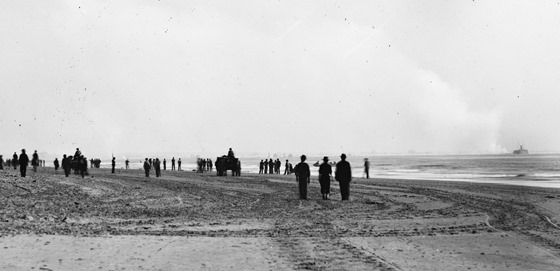 |
| Morris Island: watching USS New Ironsides firing on Rebel positions |
At midday General Gillmore, who was on the island, rode up with his staff', and ascending the lookout which had been erected on the sand-hills near the beach, and just opposite the left of our regiment, watched, through his lorgnette, the effect of the shells. During that seemingly long summer afternoon the troops on the beach witnessed one of the grandest of bombardments by land and naval forces that had taken place since the commencement of the war.

The forces on Morris Island were commanded by Brig. Gen. Truman Seymour, and the infantry was arranged in three brigades, the First under command of Brig. Gen. George C. Strong, was composed of the Forty-eighth New York, Col. W. B. Barton: Seventy-sixth Pennsylvania, Capt. J. S. Littell; Third New Hampshire, Col. J. H. Jackson ; Sixth Connecticut, Col. J. L. Chatfield ; Ninth Maine, Col. S. Emery; with the Fifty-fourth Massachusetts (colored), Col. Robert G. Shaw. The Second Brigade under command of Col. H. S. Putnam, of the Seventh N. H. Volunteers, consisted of the Seventh New Hampshire, Lieut. Co.. J. C. Abbott; One Hundredth New York, Col. G. B. Dandy; Sixty-second Ohio, Col. F. B. Pond; Sixty-seventh Ohio, Col. A. C. Voris. The Third Brigade, which took no active part in this second assault upon Fort Wagner, was commanded by Brig. Gen. T. G. Stevenson, and consisted of four excellent regiments from the forces of General Terry, which had just arrived from James Island. These troops were made up [118] of fine material, were led by competent officers, and were composed largely of regiments belonging to the Tenth Corps, with a few regiments which had formerly belonged to the Thirteenth Corps, which had been discontinued on June 11, and a few of the regiments of that corps had been transferred to the Department of the South.
 |
| Bombardment of Ft. Wagner. USS New Ironsides can be seen on lower right. |
Col. R. T. Graham, who had commanded the Confederate forces on Morris Island during the engagements on the l0th and 11th, had been relieved on the morning of the 14th by Brig. Gen. William B. Taliaferro, who at once placed their fortifications in the best possible condition for defense, and the Confederate garrisons were largely increased.
The tide serving about 4 o'clock p. m., the iron-clads closed in to within about three hundred yards of Wagner, and the mortars and guns of the land batteries and every available gun of the naval forces now opened with renewed energy, and the sixty-four guns and mortars of our land and naval forces combined, were promptly answered by the heavy guns, some thirty or more, of Forts Sumter and Moultrie, Battery Gregg, and the heavy batteries on James Island ; the deafening roar of about one hundred guns of the heaviest calibre, worked with such rapidity, seemed almost unbroken. Rear-Admiral Dahlgren received a signal from General Gillmore during the afternoon, informing him that an assault would be made at twilight. This signal, it seems, was read by the Confederates, but the increased attack from the land batteries and the fleet would naturally forestall such an event. In the midst of this heavy firing a boat crew was called for, and the old crew of the colonel's barge at St. Augustine at once responded, under Corporal Palmer, of Company F, and rowed out to one of the advanced monitors, to carry an officer, with a communication from the general. The damage in our trenches from the heavy fire of the enemy [119] during the day, had been slight. A caisson was exploded in one of our batteries by a shell, and a few casualties occurred. Our earthworks had been carefully constructed, and afforded our artillerists considerable protection.
From our position on the beach we could see the shells exploding in and around the fort, the clouds of dust rising high in the air, as they plunged into the loose sand of which it was built. Three times the rebel colors were shot away, and as many times a few daring men came out upon the parapet and raised them again. Ignorant as was everyone, from the commanding general down, of the construction of the fort, it seemed as if that shower of ponderous missiles, bursting all around them, must destroy or drive away the garrison. However, we were soon to be undeceived. Long and dreary seemed the hours of the afternoon as we lay upon the hot sand of the beach, scorching in the rays of an unclouded sun, and speculating upon the results of the bombardment. Just before sundown General Gillmore called up his brigade commanders, with General Seymour, and upon Colonel Putnam's return we learned that an assault had been determined on, — contrary to his advice, as he said. "I told the general," said he, "I did not think we could take the fort so, but Seymour overruled me; Seymour is a devil of a fellow for dash." To Major Henderson he remarked, "We are all going into Wagner like a flock of sheep." Immediately upon Colonel Putnam's return the regiment was ordered to fall in, and we could hear the commands given in the brigade in our front. We have no doubt that our troops had been seen all day upon the beach from the lookouts at Fort Sumter, and that they knew we were massing troops for some purpose. The dysentery, which prevailed among the troops while on Folly Island, had enormously swelled the sick-list of the Seventh, and the adjutant that morning at roll-call reported to the brigade commander but four [120] hundred and eighty officers and men present for duty after the line was formed.
 |
| Seventh New Hampshire Sergeant's Uniform |
The regiments of the Second Brigade formed in column by companies, the Seventh New Hampshire leading, it being the regiment of the ranking colonel. It was then we knew full well the meaning of such a movement, and as the rays of a glorious sunset shone upon the bright, fixed bayonets of our troops, it blended with the pale, uplifted faces of our comrades, whose firm, resolutely compressed features we knew meant "victory or death." Not a man asked to leave the line. There was no apparent show of fear upon those visages, as we looked along the line in pride at the noble representation from the Old Granite State, and, probably, not one in those crowded columns realized at that moment that perhaps one fourth of their number would be "mustered out" ere the rising of another sun.
The command, "Forward," was given. The Fifty-fourth Massachusetts (colored) had already left the advance works on the double-quick, with the brave Col. Robert G. Shaw at their head, closely followed by the First Brigade under dashing Gen. George C. Strong, and they in turn supported at half brigade distance by the Second Brigade under the gallant Putnam, of the Seventh New Hampshire, whose soldierly bearing instilled more courage into his troops, than any officer we ever saw in the service during the whole period of the war. We shall never forget the scene. As he sat on his horse, facing the left flank of his brigade (which was then in column by company), attired in a common soldier's blouse without straps, he looked every inch a soldier.
The command, "Forward," was given. The Fifty-fourth Massachusetts (colored) had already left the advance works on the double-quick, with the brave Col. Robert G. Shaw at their head, closely followed by the First Brigade under dashing Gen. George C. Strong, and they in turn supported at half brigade distance by the Second Brigade under the gallant Putnam, of the Seventh New Hampshire, whose soldierly bearing instilled more courage into his troops, than any officer we ever saw in the service during the whole period of the war. We shall never forget the scene. As he sat on his horse, facing the left flank of his brigade (which was then in column by company), attired in a common soldier's blouse without straps, he looked every inch a soldier.
 |
| The 54th Mass. Attacks Fort Wagner |
As soon as the Second Brigade had passed our outer line of works, the firing of our batteries and the fleet at once ceased, and Colonel Putnam deployed his brigade into column by battalions, and the different regiments of the [121] brigade closed up to less than half distance. So narrow was the neck of land between our advanced works and Fort Wagner, that, small -as was our regiment in numbers, only six companies could dress in line, and consequently four companies had to march en echelon to the rear. Then as if aroused from sleep Fort Wagner opened its batteries. Its heavy siege guns, howitzers, and forty-two-pounders poured a fearful cross fire of grape and canister upon the narrow neck of sand along which the crowded columns of the storming party must advance, while the profile of the parapet of Fort Wagner was outlined against the dark thunder clouds rising behind, by' the sparkling fire of the rifles of the garrison, who, secure in their immense bomb-proof during the long hours of the bombardment, had sprung to the parapet upon its cessation, to repel the expected assault. Besides the storm of iron hail from Forts Wagner, Sumter, and Moultrie, and Battery Gregg, all the batteries on James Island were throwing shells and shrapnel, and the nearer ones grape and canister, working their guns for all they were worth, plowing wide swaths through our ranks, which, however, were quickly closed. For a moment the brigade was halted, at the moment that the regiment under Shaw, and the First Brigade struck the enemy's picket line — which time the writer of this occupied in placing a tourniquet upon one of the men in Company D, Hinckley D. Harris, by name, whose right leg was badly shattered at the knee by a grapeshot, and we had barely time to affix the instrument, the grape and canister in the meantime splashing the water into our faces; for the left of the regiment then stood in the edge of the marsh on the left of the narrow neck of land, and the water was a foot deep or more where we stood — when we heard the ringing command, "Forward," from Colonel Putnam, who was ever on the alert to have his brigade on time; besides which we distinctly remember [122] the order given by Lieutenant-Colonel Abbott, which was, "Seventh New Hampshire, keep closed on the colors."

Springing to their feet the line pushed on into a storm of shot that seemed to fill the air like the drops of a summer shower, after that it was hard to know or hear any command, as there was such a noise from the shells and guns, together with the shrieks and cries of the wounded. All this time it was growing darker, and upon nearing the coveted works we went in on the double-quick. We passed their outer works and opened to let the remnant of the First Brigade with Shaw's broken battalion pass through on their way to the rear, for they had nobly borne the first shock, their onset being so fierce and heavy that they were badly shattered, and the Second Brigade had the front.
Closing up as well as possible the regiment reached the ditch, a trench with sloping sides, some fifty feet in width, five in depth ; and for the whole length of the south front waist deep in water and soft mud, though at the southeast angle and along the sea front it was dry. This ditch was enfiladed by heavy howitzers, which kept up a constant fire of grape and canister, and the sides and angles of the fort and the ditch itself were covered with the dead and wounded. In the angles of the ditch especially we noticed they lay piled one upon another, and there was no chance to get down into the ditch without climbing over these bodies.
Closing up as well as possible the regiment reached the ditch, a trench with sloping sides, some fifty feet in width, five in depth ; and for the whole length of the south front waist deep in water and soft mud, though at the southeast angle and along the sea front it was dry. This ditch was enfiladed by heavy howitzers, which kept up a constant fire of grape and canister, and the sides and angles of the fort and the ditch itself were covered with the dead and wounded. In the angles of the ditch especially we noticed they lay piled one upon another, and there was no chance to get down into the ditch without climbing over these bodies.

Before starting on this charge Colonel Putnam directed that the cap should be removed from the rifles, as our dependence must be on the bayonet should we come to fighting. In the regiment just behind us (the One Hundredth New York), this order was neglected, Colonel Dandy saying that his men never fired without orders, a statement sadly and signally disproved within an hour. The right of the regiment crossed the ditch near the southeast angle. [123] and found a small portion of the First Brigade on the parapet near that angle; the companies on the left finding the ditch in their immediate front impassable, crowded around to the right, and crossed the ditch near the same angle, while the four companies en echelon, passed clear around the right, and some of them scaled the parapet of the fort upon its sea face. The next regiment in our rear (the One Hundredth New York) came promptly up to the ditch and in the darkness, which was only lighted up by the flashes of the guns, saw the parapet covered with men, and supposing them to be Confederates, fired into them, undoubtedly killing and wounding many of our men. As it had now become very dark we could only see our way when the flashes of the rebel guns which swept the moat, lit up the ghastly scene for a moment only, but at short intervals. But we mounted the parapet of the fort, only to find that the stronghold was so constructed as to be almost impregnable; and some mistake or delay in giving orders to General Stevenson, prevented the Third Brigade coming to our aid. It was now nearly 10 o'clock.
 |
| http://tofindtheprinciples.blogspot.com/2011/09/honoring-amhersts-african-american.html |
We had already driven the rebel gunners from some of the nearest guns, but only to find that other guns which we had not seemed to find in the darkness, swept the traverses. After waiting for reinforcements, and holding the whole southern face of the stronghold until it was impossible to stop longer, our ranks having become so badly thinned and broken, we retired in as good and quick order as possible under the circumstances, for it was about as difficult to pfet back as it was to go on. Therefore, after some skillful engineering, as we thought, to escape the missiles thrown after us, the remnant of our brigade reported at our outer line of entrenchments where we found the Third Brigade drawn up in line to resist any sortie the enemy might make, and leaving on the field behind us and at the fort upwards of six hundred of our brave com- [124] rades, among them our heroic brigade commander, who was shot through the head and instantly killed on the parapet.
The loss of the Seventh New Hampshire in this assault was two hundred and sixteen killed, wounded, and missing, and of this number eighteen were officers, eleven of whom — including our gallant and beloved colonel — were either slain outright or mortally wounded and left in the enemy's hands.
After crossing the ditch all regimental action ceased, and each action seemed an individual one, and will be best illustrated by quoting from the narrative of Adjt. Henry G. Webber, who says: "Crossing the ditch at or near the southeast angle, I found myself, on reaching the crest of the parapet, in a corner where the bomb-proof, rising some six feet higher than the parapet, afforded a protection in front from the enemy's fire, and crowded upon the parapet, the slope of the bomb-proof, and in the corner were one or two hundred men from all the regiments in both brigades, among whom the few that I could make out as belonging to the Seventh New Hampshire were scattered. It was in vain that I tried in the tumultuous crowd, to get them together. All was wild uproar, with the groans and cries of the wounded: men calling for their officers, officers calling for their men, and many in wild excitement yelling with no apparent object but to add to the confusion. Captain Brown, of Company K, stood upon the bombproof, trying in vain to excite some men to follow him. Captain Rollins, of Company F, Lieutenants Knowlton and Bennett, of Company D, had all crossed at the same point, and no two men who stood together belonged to the same company, if by chance to the same regiment.

Colonel Putnam, delayed by his horse being shot from under him, now appeared upon the fort, and ordered an attempt to charge and silence one of the guns that flanked [125 ] the sea face, and still swept the top and sides of the bomb-proof with grape.
Lieutenant Bennett and myself then joined Captain Brown upon the top of the bomb-proof, and a few men moved to follow us. The position of the gun could be plainly seen in the gathering darkness, by the burning fragments of cartridges before its muzzle, but right across the path yawned a wide, deep, black pit — an opening into the bomb-proof in rear of a seaward embrasure, up from which came occasional shots. To the left was apparently a chance to get around, but the road was blocked by a crowd of men, sitting, lying, or standing; some disabled by wounds, some apparently paralyzed by fear. As we attempted to force a path through them a shell burst in our midst. Bennett was killed. Brown mortally wounded, and one of my legs went out from under me, and refused duty. The men fell back and I crawled over the edge of the bomb-proof again, among the increasing throng of wounded and dying, to see how much I was hurt, and was relieved to find it more of a bruise than a wound, from which the numbness soon began to pass away.
"Colonel Putnam went up on the bomb-proof, and endeavored to get up a charge, but in vain after which, drawing his men into the crowded corner of the fort, he endeavored to hold out until reinforcements, for which he had sent, should arrive. The enemy made one charge upon us, but were driven back by our fire. Shortly afterwards a ball through the head stretched Colonel Putnam among the slain, just as he had announced to Captain Rollins his determination to hold out to the last. Major Butler, Sixty-seventh Ohio, Captain Rollins, and myself, were now the only officers left, and the small force of men was woefully thinned, while the dead and dying were piled over the small space we held. [126] "So long a time had elapsed since reinforcements were sent for, that Major Butler began to tear that the officer who was sent had failed to cross the belt of tire that still swept the outside of the ditch, and expecting a charge every moment, to which our small force could oppose but feeble resistance, he at last gave the order to retreat, and taking a last shot over the bomb-proof, we silently skedaddled toward our lines."
Five officers fell before reaching the moat which surrounded the work. Of the line, Captain Brown and Lieutenants Cate, Baker, Bennett, and Bryant, fell dead on or near the works. Captain Leavitt lived until he reached Charleston. Captain House died of his wounds in October, and Lieutenants Davis and Worcester died on board transports, after they were exchanged. All other wounded officers recovered. It is an historical fact that in this assault the Seventh New Hampshire lost more officers than any other regiment in any one engagement during the war.
General Strong and Colonel Chatfield, of the Sixth Connecticut, had fallen mortally wounded near the fort, while leading the First Brigade, and General Seymour was severely wounded by a grape-shot, while the Second Brigade was moving up, and was obliged to leave the field.
Had the Third Brigade come to the assistance of the Second Brigade on the evening of the assault on Fort Wagner, and sent two of its regiments around the sea front of the fort to the rear of that stronghold, the Union forces would have taken the fort and its garrison; and instead of smashing two good brigades upon the fortified front of such a formidable earthwork, a portion of one of the brigades engaged, would have been sufficient to hold the front while two good regiments passing around the work to the rear, which was almost wholly unprotected, and which movement would have been a feasible one, would [127]
have successfully terminated the assault. Why our general officers who had the advantage of a military education should have seemingly overlooked the advantage of such a movement is not clearly comprehensible. Even noted Confederate authorities seem never to have given a thought to the accomplishment of such a movement, which could have been easily made, and the long and arduous siege and consequent loss of life have been averted. Such a movement would also have shown conclusively the fault of constructing a formidable earthwork with the rear almost wholly unprotected.
The morning of the 19th was Sunday, and an inspection of the troops upon the island was ordered, and only nine officers and two hundred and fifty-eight men appeared on the line of the Seventh New Hampshire as present for duty.

Company C had lost every commissioned officer. First Lieut. Virgil H. Cate had only lately been exchanged and returned to the regiment, and was acting aide-de-camp to Colonel Putnam. Second Lieut. Andrew J. Lane was killed before reaching the fort. Of the two hundred enlisted men who were either killed, wounded, or missing, I desire to speak in particular, because without them where would the glory and fame of our regiment have been? Good, faithful, brave men and tried even unto death. They were of the best we had. Their memory we shall ever cherish, and as we recall the faces and pronounce the names of those comrades who were missing on that eventful evening of July 18, 1863, we find they were men whom we would have chosen for any emergency. First Sergts. Gilbert F. Dustin, of Company D ; Alexander S. Stevens, of Company E; Thomas F. Meader, of Company F; Charles C. McPherson, of Company I: and Jacob W. West, of Company G, who died of his wounds August 5, "went in to stay," and the loss of these five first sergeants [128] was sadly felt by the companies to which they belonged. Only a few, a very few of our wounded men ever came back to us. Nearly all of our missing comrades proved to have been either killed or wounded and died in rebel hands. The squad of men who were captured from Company D, at St. Augustine, Fla., had been returned but a short time to the regiment, and some of them were that evening either killed or again captured. At least no tidings ever came of them. Every company had its list of killed and wounded, and scores of New Hampshire homes went into mourning for those who never returned.
The men who were wounded were generally found to be seriously so, making it very much the worse for them, as it was impossible to get those badly wounded comrades back to our lines ; and as we were compelled to retreat on the double-quick, those who had not been able to get back by their own efforts, and those who were left near the rebel works had to be left to the mercy of rebel hands.
---Henry F. W. Little. The Seventh Regiment New Hampshire Volunteers in the War of the Rebellion. Seventh New Hampshire Veterans Association, Concord, N. H., 1896.
 |
| Fort Wagner, July 19, 1863. Harper's |


