Originally published
in Found Object, Winter/Spring Issue, Number 2
(January/February 2001)

The Origins of Ethics in Marx's Writings
How are we to understand the ethical content of Marx's work? Is there a socialist ethic or an ethics of socialism? Of course, these are not new questions within the marxist tradition. One hundred years ago, debates over "ethical socialism" coincided with those over accumulation, imperialism, organization and party. Although the question of ethics has been raised most recently by neo-liberal and neo-authoritarian critics, the turn to the question of ethics has not occurred for intellectual reasons. It is occasioned by the passing of state capitalism in the USSR and by the simultaneous critique of the adaptation by the Left of the discursive categories of bourgeois science in the forms of scientific socialism and the science of historical materialism. However, to raise the question of ethics is one thing, but to uncover its location within critical theory is quite another.

Broadly
speaking, responses to the question of ethics have displayed two
theoretical tendencies. In the first tendency, there is a
moralization of Marx through the construction of the "young
Marx." This tendency identifies the entirety of Marx's critique
of morality with his readings of Hegel and Feuerbach, the assumption
being that Marx's critique of morality is restricted to these early
works, leaving the impression that his materialism is at best
discontinuous from his critique of morality, and, at worst, simply
derived from a previous, enlightenment moral theory.
The
second tendency is that of the so-called orthodox marxists who hold
that ethics are merely the reflection or representation of economic
determinations, simply a transparent feature of the
base/superstructure model. This view also displays strong
evolutionary arguments (see Kautsky and cf. Habermas). Like the
first tendency, the effort here is to restrict ethics to Marx's early
works. However, the goal is not to moralize the works but to
transform the later works into Promethean discourses of modern
science, what Max Horkheimer called "Traditional Theory."
The reduction of historical materialism to a science of social
development attempts to remove ethics from consideration because of
its "unscientific" nature. The very fact that ethics exist
as unscientific simply means that at least one aspect of
critical theory can not be reduced to the disciplining of science --
and it also means that there are possibly many more. Of course,
these tendencies are not mutually exclusive, and evidence of both can
be found in the writings of marxists as different as Althusser and
Habermas, but to answer the question of ethics in Marx is to also
critique the moralization of Marx, as well as the adoption by
marxists of the techniques and discourses of modern science. For
Marx, ethics and morality do exist scientifically, i.e., they
exist both historically and materially. Marx's view of
ethics is, in other words, an active expression of a materialism that
holds the promise of emancipation.
This
essay, by starting with Marx's later works, and particularly with the
Grundrisse, departs from the two aforementioned tendencies by
deriving Marx's ethics from his materialism, demonstrating that if we
open the question of ethics in the later works, the ethos that
emerges provides little comfort to those who would turn Marx into
either a moralist, or a scientist of the social. Marx's project of
"ruthless critique of all things" certainly included the
critique of bourgeois ethics and morality. It is precisely because
ethics are most often sought after or confined to Marx's "early
works" that the question of ethics allows us to touch on the
issues of the "young Marx" and the idea of an
epistemological break, Marx's critique of morality, the place of this
critique within the entirety of his development of materialism, and
the relation of ethics itself to materialism. By beginning with the
later works, I make an implicit argument for a large measure of
continuity in Marx's project. It is true that works like the Holy
Family are more overt critiques of morality, and we will discuss
this work in more detail later. It is also true, I will argue, that
these works should be seen as moments in Marx's overcoming and
exposing of bourgeois morality and that the results of this critique
are to be found within a later work like the Grundrisse. It
is, to be sure, a critique different in style and depth than that
found in the early works. Marx himself is often critical of these
early efforts, but they are nonetheless continuous with his
development of a materialism praxis. We can find a discourse on
morality and ethics in the Grundrisse, but it is a discourse
that pointedly avoids all sentimentality, development, or
predetermined categories such as good and bad. It is a discourse in
which ethics are derived from the practice of struggle. The
struggles around morality are not a struggles over values, but
conflicts in which each class is expressed in their means of
reproducing the very struggle that creates them -- and finds
emancipatory expression in their practices of resistance, pleasure,
and authority, i.e., in their sensuous social activity.
Marx
moved beyond the question of human nature or essence, Althusser
notes, and towards a critical analysis of the reproduction of the
everyday world of capital. If we do not identify this critique with
bourgeois political economy, then we are obliged to view the concept
of an epistemological break -- despite its value in showing Marx's
overcoming of Hegelianism -- as concealing the continuity and
development of Marx's materialism. By taking production as his
stating point, Marx attempts to address a fundamental problem of all
previous materialist philosophy identified in the First Thesis on
Feuerbach as the problem of sensuous activity, pleasure and freedom.
While Marx's rejection of Hegelian idealism was complete, his
rejection of Feuerbach's critique is not a rejection of materialism.
"The separation from the Hegelian School was here also the
result of a return to the materialist standpoint" (Engels
1941:43) and the practical tasks of materialism, which always consist
of "denouncing all myth, all mystifications, all
superstitions" (Deleuze 1994:270), and ultimately changing the
world.
The "Young Marx"
The ethical question is not a question of a "young Marx" vs. a mature Marx. Althusser was correct to see the construction of the "young Marx" as both a theoretical problem as well as a practical tactic of social democrats opposed to the Bolshevik party ideologies within the Cold War Left. Instead, the ethical question is fundamentally, "Which Marx? The Hegelian or the materialist?"
Althusser
rightly noted that Marx systematically rejected both Hegel's idealism
and Feuerbach's materialism, purging his work of both humanism and
essentialism. This means that he rid himself of any ethics based
upon an abstract notion of human nature or rights. Althusser
maintained, however, that what remained after this revolution of
subjectivity was a science of historical materialism. Aronowitz
decisively critiques this move on the grounds that Althusser mistakes
materialism, which is always a revolutionary ideological practice,
for bourgeois science (Aronowitz 1988). There is indeed, one might
say, a Hegelian Marx, else Marx and Althusser would not have spent so
much time exorcising him. Nor would Lenin have suggested that one
read Hegel's Logic to understand Capital. Of course,
the Grundrisse was unknown to Lenin, but to follow up on a
suggestion made by Nicolaus, with the Grundrisse it is no
longer necessary to see Marx through Hegel, but instead as a
materialist who gave us an alternative understanding of the
dialectics of history and materialism.
At
the same time, some writers like McCarthy in his otherwise admirable
Marx and the Ancients,
attempt to transform Marx's work into the discourse of Greek
philosophy, as though Marx simply returned to the Greeks. These
works exaggerate the continuity and at the same time they forget that
what Marx said about Greek art is equally true of Greek philosophy:
"One can not become a child again without becoming childish"
(1973:103). In his dissertation, Marx critiqued Epicurean philosophy
as an ascetic and contemplative philosophy that justified a
withdrawal from the everyday world into the garden of philosophy.1
To find the ethical content of the Grundrisse,
we can look to the example of Epicurus, who derived his ethics,
including an egalitarianism and freedom quite uncharacteristic of
most Greek philosophers, from his physics. In much the same way, we
must derive Marx's ethics from his materialism. This is in fact how
Marx undertook his own work on Epicurus: ". . . instead of
presenting moments out of the preceding Greek philosophies as
conditions for the life of the Epicurean philosophy, I reason back
from the latter to draw conclusions about the former and thus let it
itself formulate its own particular position" (1975b:493).
As
we mentioned earlier, because the Grundrisse begins with the
production of difference, it also has indeterminacy at its center.
Determinism, Marx noted in the dissertation, is a crucial question of
materialism. In his study of Democritius and Epicurus, Marx
concluded that despite what he understood as Epicurean materialism's
contemplative stance, it was a major advance over the Democritean
system, which viewed the fall of the atom as determined, and removed
chance from the workings of nature. While Democritius held that the
atom fell in a straight line, and hence the experience of the world
was essentially determined, Marx notes that Epicurus advanced the
thesis that instead of falling in a straight line, atoms are subject
to spontaneous swerves because of their effects upon one another. In
this spontaneous swerve of the atom, Epicurus located his argument
for the immanence of freedom in nature, and a world not determined
for people, but made by them (Marx 1975). It is instructive to note
that De Santillana (1961) sees the same element of freedom in
Epicurean materialism that Marx discerns, and also goes further to
interpret Epicurus and his more famous follower Lucretius within the
political context of their time (a task that Marx did not do in his
dissertation). Rejecting the repressive weight of Hamlet's "dread
of something after death, the undiscovered country from whose bourne
no traveller returns, puzzles the will," De Santillana seconds
the traditional view of Epicurus as the first to bring humans to the
status of god, or god to the status of human invention, and thereby
free us of this myth: ". . . the man who destroyed the whole
foundation of religious faith and overturned the altars and the
temples of the gods, not by manly force, as Xerxes did, but by the
force of argument" (Cicero 1972:116). And in doing so, the
determinism and unity of divinity gave way to a materialism that
located spontaneity and difference in nature. For materialism,
chance is
an
initial element of indeterminacy, of spontaneity, at the core of the
atom, so that it should work out as freedom at every point, in nature
and specifically in life. . . . The message, in any case is clear:
freedom does not come . . . from above, and to the elect as Plato
would have it in his Laws; it comes from the very core of
things, within life itself. Hence it is every man's [sic]
inalienable inheritance. (De Santillana 1961:291-292)
But we can not really say that
Marx returned to Epicurus. Marx had long before, in his
dissertation, condemned even Epicurean materialism as a contemplative
and ascetic philosophy (which is also how Nietzsche would later
describe it).2 However, it did have some very
positive elements that Marx highlighted. It derived its ethics from
its materialism, and more importantly, Epicurean materialism lacked
essentialism. It placed all humanness into the sensuous experience
of an indeterminate nature.3 Marx is
particularly impressed with Epicurus locating freedom in nature
itself, in the spontaneous swerve of the falling atom, and not in a
transcendental category or in an essentialized Human Nature. Humans,
from their sensations to their thoughts, never stand apart from
nature. Epicurean materialism immersed all humans in the sensuous
experience of an indeterminate nature. Marx in the Grundrisse
does the same with the social relations that make us human.
The
Grundrisse
and Capital begin
at a very different moments.4 Capital,
for reasons of political practice, begins with the commodity and with
the fetishism of commodities. I.I. Rubin convincingly places the
fetishism of commodities at the center of Capital.
"The theory of fetishism is, per
se, the basis of
Marx's entire economic system . . . revealing the illusion in human
consciousness which originated in the commodity economy and which
assigned to things characteristics which have their source in the
social relations among people in the process of production"
(Rubin 1993:5). But it is not Marx's
economic system-- for he proposed no such theory -- but "the
many capitals of capital" that spread with the commodity form to
every corner of the social world.
Capital begins with
difference, with the multitude of commodities that appear
as one vast accumulation, as the unity that reveals the imperialism
inherent in commodity production (Luxemburg 1964). In the relentless
drive by capital to overcome all limits, production must be subsumed
under the commodity form. Rubin's analysis shows how Capital
is an immanent critique, starting necessarily from the capitalists'
own understanding of the world as a world of commodities. As
described by Marx, it is the fetishism of commodities that gives the
appearance of an infinite market of difference, but this difference
is a mystery whose solution reveals the unity of capital accumulation
made real by its essential imperialism. In the Grundrisse,
Marx replaces the fetishistic difference of commodities with the real
difference of production.
The
Grundrisse is first distinguished by the fact that it is not
written from the perspective of the capitalist. Instead, it is
written from within capital, by an active opponent of capitalist
relations. The Grundrisse does not begin with commodities but
with "material production. Individuals producing in society --
hence socially determined individual production by an animal which
can individuate itself only in the midst of society"
(1973:83-84). But in starting with production, Marx avoids the error
of bourgeois political economy, which also starts with an
abstract discussion of production. Instead, he opposes the a
priori totality of "production in general." Horkheimer
further reminds us that for "traditional" or "scientific"
theory, "production is the production of unity, and production
is itself a product." Classical political economy is marked by
a "determinative, ordering, unifying function" that serves
as the "sole foundation for all else, and towards it all human
effort is directed." This unifying function expresses itself as
the "consciousness of the bourgeois savant in the liberal era"
(Horkheimer 1972:198), and is opposed to critical theory, which holds
that production is the production of difference. Political economy,
in both its marxist and its bourgeois forms, aims to describe
production "as encased in eternal natural laws independent of
history, at which opportunity bourgeois relations are then smuggled
in as the inviolable natural laws on which society in the abstract is
founded" (Marx 1973:97). Marx's work is a critique of
political economy. Horkheimer is simply paraphrasing Marx's statement
that "the whole profundity of those modern economists who
demonstrate the eternity and harmoniousness of existing social
relations" lies in forgetting "that each determination is
itself segmented many times over and splits into different
determinations" (1973:85). The "essential difference"
within any determination should never be forgotten. Production as an
abstract unity, "production in general" did not concern
Marx. And if "there is no production in general, then there is
no general production, or it is always a particular branch of
production, or it is a totality [comprised of many branches of
production]. Production is also not only a particular production,
rather, it is always a certain social body, a social subject, which
is active . . ." (1973:85).
Production
-- material production -- is the production of difference. But the
production of difference is at the same time the consumption of this
difference. In fact, it is this dialectic of production and
consumption that Marx uses to demonstrate both his debt to and his
overcoming of Hegel's dialectical method. For Marx states that
"there is nothing simpler for a Hegelian than to posit
production and consumption as identical" (1973:93), but it is
not Marx's goal to prove this identity, but to critique it, to expose
the non-identity of capital and labor, and thereby show that
production is not merely consumption, but also the consumption of
difference: "productive consumption" Marx calls it. In
maintaining that production is the production of difference, Marx
does not close off dialectical development, but opens it up to spiral
ever further, acknowledging a fundamental indeterminacy to social
relations. In a world of socially individuated humans producing in
society, production is never the abstraction of "production in
general," but is always expressed in material difference, i.e.,
in class. And ethics are inherent in the determinations of class,
for Marx does not allow us any generalizations, even that of society.
"This so-called contemplation from the standpoint of society
means nothing more than the overlooking of the differences which
express the social relation ( of bourgeois society). Society does not
consist of individuals, but expresses the sum of the interrelations
within which these individuals stand" (1973:264-265).
The
Grundrisse
is best understood as the foundation of a materialist critique. If
we want to understand ethics in the Grundrisse,
then we must see it as the foundation of a materialism that derives
its ethics from the experience of social bodies immersed in the
historical activity of the production of difference. For the
Grundrisse
has difference at its center, in other words, it has the historical
indeterminacy of class struggle at its center. And Marx, to
emphasize the point again, is not writing about this struggle from
the perspective of the capitalist. Thus, it is difference that
allows us to derive the ethical content from a work that rarely
mentions the word "ethics." For the entirety of this
essay, I take seriously the possibility that the Grundrisse
is truly the foundation of an exposition of materialism. My argument
will proceed bearing in mind that any discussion of ethics is obliged
to avoid the trap of searching for moralizing statements in Marx's
texts, and instead locate the ethical content in the critique itself,
i.e., within materialism. Morality, Marx said, is a particular mode
of production (1978:85).
The Critique of Bourgeois Morality: life as sensuous activity
In some ways, The Holy Family is the first work of Cultural Studies, or at least of Critical Theory. All of the concerns are there, popular culture and the media, the "mass," authority, morality, punishment and ethics, the method of immanent critique that is to form the basis of the critique of political economy, and the technique based upon immanent critique and close reading. The texts (Sue's novel, the newspaper, the review of the novel) are deconstructed and recombined, with the addition of Marx's critique, into a new text. One moves from the review of a popular novel to the critique of Hegelianism itself, as well as a Nietzschian critique of morality. Certainly, it is a defiant rejection of bourgeois morality, ethics, and sexuality. Perhaps this is what is so important about The Holy Family, that it is where Marx takes up the problems of ethics and ethical life, following Rudolf through Parisian society in much the way one follows "ethical self-consciousness" in the Phenomenology through its development (another turning of Hegel on his head).5 It is also a critique that is never again given an extended, or explicit, treatment -- although one does hear it in the Manifesto in Marx's denouncement of marriage as a respectable form of prostitution and slavery. It is a critique that Marx himself critiques for its humanism, but the critique itself, as a ruthless critique of ideology, is never renounced. Indeed, The Holy Family was written at the same time as the Economic and Philosophic Manuscripts, and so it is not the result of a youthful Marx's naiveté or an early Hegelianism, as it was at this time that Marx overcomes Hegel. A certain indeterminacy lies at the heart of Marx's critique of morality, but Marx realized that to critique morality was not enough. Marx therefore carries over his critique of the social relations of morality to his critique of political economy and social relations in general. The multiple determinations and overdeterminations of historical relations express the indeterminacy of nature and our attempts to control and rationalize it, first through others (slavery), and then directly (commodification, management, and supervision) and which has its expression in new forms of discipline and control (Marx 1973; Marx I, 1976; Deleuze 1994).
Marx
establishes his position, which is an essential aspect of materialist
philosophy, that there is no good or bad. The opposition of good and
bad is not a dialectic, he says, but only a "mystery" of
bourgeois morality. This view goes to the heart of his critique of
Proudhon as having merely modified Hegel's Dialectic, making "every
economic category" have two sides
.
. . one good, the other bad. He looks upon these categories as the
petty bourgeois looks upon the great men of history: Napoleon was a
great man; he did a lot of good; he also did a lot of harm. The good
side and the bad side, the advantages and the drawbacks, taken
together form for M. Proudhon the contradiction in every economic
category. The problem to be solved: to keep the good side, while
eliminating the bad. [Marx then mocks Proudhon.]
Slavery
is an economic category like any other. Thus it also has two sides.
Let us leave alone the bad side and talk about the good side of
slavery[!]. . . . (1978:104-105)
Marx
accuses Proudhon of having read Hegel's ethical development of the
spirit as expressing essential ethical qualities of good and bad.
For Marx, ethics exist in the material situation itself, in this
example, in the institution of slavery. The good of slavery is that
without it, you would have no cotton, and no modern industry, and no
world trade. "The value of slavery is not in any good inherent
in the abstract concept of its thesis -- we have left aside its 'bad'
side -- and it seems that the 'good' side is good only relative to
whether you think that it is 'good' to have a system built upon
slavery at all" (Marx 1978:105).
To
remain within materialism, and not be reduced to the negative
abstraction of good and bad, ethics must be derived from sensuous
experience. Bourgeois morality seeks to limit sensuous experience at
every opportunity because such limits are seen, as Freud pointed out,
as the essential foundation for social life. This limit is a limit
not of nature -- which the very indeterminacy of its material
existence endows it an almost infinite productive potential (Epicurus
1964:11) -- but always a limit of capital. Freud later found, but
could never admit, that the limits of the human psyche that he
discovered were the products of the social relations of capital and
specific to the bourgeois and petite bourgeois classes, and that even
the Oedipal relation, supposedly so universal, was experienced first
as a deployment within the bourgeoisie for the purpose of controlling
itself and only later universalized to the other classes.6
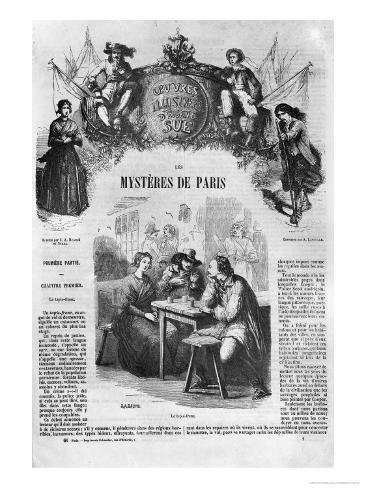
It
is sensuous experience that Marx takes up in the Holy Family,
his first collaboration with Engels. Interweaving a critique of
Szeliga's review of Eugene Sue's Mysteries of Paris with his
own close reading of the text, Marx's critiques the authority of
morality using sensuousness as the basis for human emancipation and
not as a transcendental ideal.
Marx
rejects the science of his day which regards degeneracy as an
explanation for poverty, deviance, and other social problems and
conflicts. Degeneracy is only a mystification that conceals the real
social conditions that are expressed through the bodies of humans
producing socially. Marx finds the limit to human freedom not in the
"mystery of degeneracy," but in the experience of capital
relations in the everyday world. Marx speaks of Szeliga: "He
proclaims as mysteries degeneracy [criminals, prostitutes, the
poor, etc.] within civilization and rightlessness and inequality in
the state." Marx sees no mystery in these conditions, after all
"the credo of most states starts . . . by making the high and
the low, the rich and the poor unequal before the law"
(1943:70). Szeliga proclaims degeneracy in civilization and
rightlessness in the state to be mysteries, which Marx says dissolves
them into the "category mystery" which takes on an
abstract existence apart "from present world conditions":
"Having produced the category "Mystery" out of the
real world, he produces the real world out of this category (75-76).

Rudolph,
the Sue's protagonist, roams the streets of Paris, encountering
representatives of the various social classes. But in Szeliga's
review, even Sue's bourgeois morality, which at least recognizes the
existence of other classes and moralities, is reduced to the category
of "mystery." Of course, Feuerbach also used the metaphor
of mystery, "but whereas Feuerbach disclosed real mysteries,
[Szeliga] makes mysteries out of real trivialities. His
art is not that of disclosing what is hidden, but of hiding what is
disclosed" (Marx 1980:70). Rudolph's journey through the
mysterious social hierarchy of Paris consists precisely in this
hiding of what is disclosed, for no sooner is a "mystery"
exposed than its expressive, affirmative aspect is subsumed under the
sign of bourgeois morality and an ethic of bad conscience and
revenge. In fact Marx effectively shows the role of revenge and
punishment in Rudolph's administration of justice, thereby putting
punishment at the center of Rudolph/Sue/Szeliga's bourgeois morality.
Rudolph's
is a reactive stroll. The stroll has become familiar in some genres
of critical theory. Closely associated with urbanism, the stroll,
which dates as a theoretical subject to Simmel, Baudelaire, and
Benjamin, is often conceived of as an emancipatory experience, an
example being Deleuze and Guattari's discussion of Buchner's "Lenz"
(Deleuze and Guatarri 1983:4-5). Lenz on his stroll is removed from
the conditions that require that he "constantly situate himself
socially, in relationship to the god of established religion, in
relationship to his father, to his mother," and to the
reproduction of capitalist relations. On his stroll Lenz experiences
"not nature as nature, but [nature] as a process of production"
(Deleuze and Guattari 1983:2). His stroll "emancipates him from
the jail-yard of individual relations" (Emerson 1887).
Conversely, Rudolph's stroll can be read as the steady accumulation
of the very limits that Lenz seeks to momentarily escape. Rudolph
seeks to enforce limits, especially to limit social production to
proscribed paths (and hence conceal production's essential difference
by giving it a false identity). Possessing the ability to reform
even the most wretched person in accordance with his "impartial
judgment" (Szeliga), Rudolph sets about reforming the lives of
all the nere-do-wells he meets. In order to accomplish this task, he
either punishes them in accord with the "ruthless . . . thought
of pure criticism"
(Szeliga), i.e., punishment and torture; or Rudolph brings them into
the strictures of bourgeois morality, where "the ethics of
political economy . . . acquisition, work, thrift, sobriety"
(Marx 1978:97), dictate that they, like the characters he "reforms,"
should willingly die for their "master," having no other
need than to serve him.7 Rudolph goes to a ball
and finds the aristocracy in its everyday condition. He talks to two
of the "most beautiful among the beautiful" and he expects
to hear from them their joy regarding "the blessing of beloved
children and the fullness" of a life spent seeing to the
"happiness of a husband." At the very least, since he is
amongst the aristocracy, he expects a certain moral supremacy that
comes with political power. Instead, they gossip about adultery and
the very real and decadent, morality of their peers, opening up a
space for Szeliga/Sue's speculations on love and sensuality.

It
is here that Marx reverses the terms of the discussion and unmasks
real relations that are so easily proclaimed mysteries.8
Marx puts forward the materialist view that it is through sensuous
activity -- in love and in labor -- that humans experience the world.
It is within sensuous activity that we experience the production of
desire, the utilization of human impulses, and the historical
materiality of human relations. This sensuous activity has, since
the end of feudalism, been increasingly expressed in the production
of the general ideological practices of capital, commodity fetishism
and the concealment of bourgeois morality through the production of
the "mystery of speculative love." This is aptly shown by
the character of the parson in Sue's novel. Marx points out that the
parson's idea of love conforms to the institutional design of the
church (1980:81) and not the actual sensuality of sex. The parson
uses the metaphors of love -- which Marx deconstructs into the real
social power of the church -- to conceal the real sensuousness of
love, and to deny the very real things of sex. Szeliga asks:
What
is the mystery of love? . . . Not the shady paths in the thickets,
declaims the parson, "not the natural semi-obscurity of
moonlight night nor the artificial semi-obscurity of costly curtains
and draperies; no the soft and enrapturing notes of the harps and the
organs, not the attraction of what is forbidden. . . . All this
[curtains, draperies and organs] is only the mysterious. The
mysterious in it is what excites, what intoxicates, what enraptures,
the power of sensuality" (1980:81 interpolation by Marx).
To
which Marx acidly replies: "Curtains and draperies! Soft
and enrapturing notes! Even the organ! Let the reverend
parson stop thinking of the church! Who would bring an organ
to a love tryst?" The parson states that the "mysterious
in [love] is what excites, what intoxicates, what enraptures, the
power of sensuality." Sensuality therefore invokes the
experience of these things. Marx argues that our sensuality is
excited, intoxicated, enraptured in our experience of the world. He
says
The
parson advises us, after the fashion of speculative theology, to
recognize sensuality as our own nature, in order afterwards to
dominate it, i.e., to retract recognition of it. True, he
wishes to dominate it only when it tries to assert itself at the
expense of Reason -- will-power and love as opposed to
sensuality are only the will-power and love of Reason. The
unspeculative Christian also recognizes sensuality as long as
it does not assert itself at the expense of true reason, i.e., of
faith, of true love, i.e., of love of God, of true will-power, i.e.,
of will in Christ (1980:81).
The
parson does acknowledge that sensuality "has such a tremendous
power over us" because we will not recognize it as a part of our
nature. For Szeliga, the mysterious power of love is not to be
explained but why this refusal? "It is true that we [the parson
or the church?] do not like to admit the power of sensuality. . . ."
According to Szeliga
If
then love ceases to be the essential element of marriage and of
morality in general, sensuality becomes the mystery of love, of
morality, of educated society -- sensuality both in its narrow
meaning, in which it is a trembling in the nerves and a
burning stream in the veins, and in the broader meaning, in
which it is elevated to a semblance of spiritual power, to
lust for power, ambition, craving for glory. . . . (Szeliga in Marx
and Engels1980:81).
Marx
then gives his final blow contra Szeliga, Sue and Hegel:
The
parson hits the nail on the head. To overcome sensuality he
must first of all overcome the nerve currents and the quick
circulation of the blood.. . . . As soon as there is no more
nerve current and the blood in the veins is no longer hot, the sinful
body, this seat of sensual lust, becomes a corpse and the
souls can converse unhindered about "general reason," "true
love," and "pure mortals." The parson debases
sensuality to such an extent that he abolishes the very elements of
sensual love which inspire it -- the rapid circulation of blood,
which proves that man does not love by insensitive phlegm; the nerve
currents which connect the organ that is the main seat of sensuality
with the brain. He reduces true sensual love to the mechanical
secretio seminis and lisps with notorious German theologian: "Not
for the sake of sensual love, not for the lust of the flesh, but
because the Lord said: Increase and Multiply" (1980:82)
Love
and labor are for Marx the real sensuous experiences of everyday
life. The experience of Homo sapiens who are made human through
their social production. Love is not a spiritual bond, nor does
it represent the internal development of an absolute love in the
ideas of humans. It is nature itself in humans and it must be
dominated as nature is dominated. Even before labor there is
sensuous activity, and this remains even after it becomes human
sensuous activity through social labor. It is that part of us that
is nature, not human nature, but nature-as-nature, which is
historically prior to human social relations, although the two are
historically linked.
The
passion of love is incapable of having an interest in internal
development because it can not be constructed apriori, because its
development is a real one which takes place in the world of the
senses and between real individuals . . . what Critical Criticism
combats here is not merely love, but everything which is immediate,
every sensuous experience, any and every real experience, the
"whence" and the "whither" of which one never
knows beforehand. (Marx 1980:30)
Hence
Critical Criticism combats the everyday world of individuals
producing in society, the "whence and whether" we can not
know precisely because it is material production, and
therefore, indeterminate. It is the production of difference.
The particular production that concerns us is capitalist production,
which is a historically situated domination of social production
through the seemingly unlimited expansion of wage-labor and
the concurrent commodification of the everyday (Marx 1980: 322-324).
It is the particular character of domination that is found under
capital that necessitates that we turn our attention towards the most
terrible of expression of "moral" order, slavery.
Morality and Slavery
The domination of sensuality, or the domination of sensuous experience, is also the domination of human labor -- since it is labor that is so much a part of us and through which we create ourselves (Lefebvre 1991:74-75). Under capital, the domination of sensuous experience has its particular form in the work of supervision and management-- authority-- that pervades both family and work.9 However, as authority "necessarily arises where the direct production process takes the form of a socially combined process . . . it takes on two different forms" (Marx 1976 [III]:507). In the one, the increased cooperation inherent in the historical division of labor, authority can appear as a "governing will . . . like the conductor of an orchestra" (Marx 1976 [III]:507; emphasis added) who leads, but is not the composer. The division of labor necessitates authority, but the expression of authority is specific to any process of social production. This is the second form of authority and it is the specificity of capital production that concerned Marx. While chattel slavery is the "high point" of the concentration of supervision, capital has its own concentrations of authority. The work of supervision and management is as "indispensable in the capitalist mode of production" as it is under slavery. Moreover, there is in both the tendency for supervision and management to become separate from ownership. In the case of Roman slavery, this tendency resulted in the villicus, the manager of a slave estate. In the case of American slavery, it is found in the position of the overseer, and in the separation of the house from the field slaves. Under capital, it is the slavery of the wage. But under capital, there is a multiplicity of supervisory positions so that even the individual capitalist can appear to another as a worker, for example, the industrial capitalist might appear as such to the financial capitalist. Marx actually applies Aristotle's description of the slave holder to the capitalist. The interpolated comments are Marx's:
'For
the master' -- the capitalist -- 'proves himself such not by
obtaining slaves' -- ownership of capital, which gives him the power
to buy labor -- 'but by employing slaves' -- using laborers, nowadays
wage-laborers, in the production process. 'There is nothing great or
sublime about this science but whatever the slave is to perform, the
master must be able to order. Whenever the masters are not compelled
to plague themselves with supervision, the overseer assumes this
honor, while the masters pursue public affairs or philosophy'
(Marx 1976 [III]:509, quoting Aristotle, De Republica, Book I,
7).
Marx
explains the importance of this science:
What
Aristotle is saying, in very blunt terms, is that domination, in the
economic as well as the political, imposes on those in power the
functions of dominating, so that in the economic domain, they must
know how to consume labour-power. And he adds that this supervisory
work is not a matter of very great moment, which is why the master
leaves the "honour" of this drudgery to an overseer as soon
as he is wealthy enough (1976 [III]:509).
In
the social domain, the critique of capital relations is also the
critique of slave relations, there is, after all a reason why it is
called wage-slavery. In a sense, Marx reveals to us the paradox of
Hegel's statement that "A slave can have no duties; only a free
man has them" (Hegel 1967:261). The "free man" is
free to submit to duty. In other words, the free man has his freedom
determined by his duty, his unfreedom. The slave, having no freedom,
also has no duty. And having no duty, can not be fully human. But
this does not go far enough. The specific aspect of capital's social
domination in the capitalist mode of production is that the slave and
the "free man" become one and the same. It is not a
question of the contradictions between abstractions, but, of the
conflicts around the ownership of production and the apparatus of
supervision and administration (e.g., the state, the boss, the
teacher, the doctor, etc.). The capacity to command the labor of
others permeates the labor process in general, so that even the
capitalist appears as "a functionary of capital, as a simple
bearer of the labor process in general; as a worker, and a
wage-worker at that" (Marx 1976 [III]::505). Marx draws this
comparison of the slave and the "free worker":
The
slave is the property of a particular master; the worker must
indeed sell himself to capital, but not to a particular capitalist;
and so within certain limitations he may choose to sell himself to
whomever he wishes, and he may also change his master. The effect of
all these differences is to make the free worker's work more
intensive, more continuous, more flexible and skilled than that of
the slave quite apart from the fact that they fit him for quite a
different role. The slave receives the means of subsistence he
requires in the form of naturalia which are fixed both in kind
and quantity -- i.e., he receives use values. The free worker
receives them in the shape of money, exchange values. . . . [The free
worker] learns to control himself [his conversion of "money into
whatever use-values he desires"] in contrast to the slave, who
needs a master. (Marx 1976 [I]:I, 1032-1033)
At
no point does Marx condemn slavery on the basis of abstract ethical
concepts of good and bad. Instead, the critique of slavery serves to
underscore the need to understand the ethical content of Marx's work
in light of the materialist practice of deriving ethics from the
conditions of life. The creation of capital's "free man"
as the bearer of capital's authority -- who is in all senses the
child of the Enlightenment -- has an important place in Marx's
critique of morality, especially that of bourgeois discipline and
punishment. The critique of bourgeois punishment is continuous with
Marx's discussion of the work of supervision and management. This
is, of course, ineluctably tied to the domination of Reason over
sensual experience, which in turn intersects with human attempts to
dominate nature, and which has been shown by the impressive research
of the Frankfurt School to be a necessary aspect of the domination of
humans by other humans. Of course, this form of domination is itself
the domination of the everyday life of the person. It is in this
sense that the domination of the finite time granted by life becomes
the means by which we can understand capital as the crystallization
of dead labor (Gulli 1996; Krysl 1997).
The
versatility of the worker is the result of h(er/is) freedom and
h(er/is) freedom is the result of the subsumption of h(er/is) work to
the relations of capital. Versatility is an immediate result of the
worker subsumed under capital. Capital colonizes differences so that
instead of producing freedom, they produce the desire for exchange
values. The alienation of the person's labor (and their labor from
that of others), becomes a desired object (commodity) that stands
outside, and above, the labor that produced it. Difference, the
origin of freedom, instead is produced so as to deny freedom. The
versatility of the worker under the societies of discipline, already
the denial of the freedom of the free worker, gives way to the
continuous difference, the constant "retraining" of the
present societies of control (Deleuze 1990).

Remarks
In the preface to his dissertation, Marx quotes Aeschylus' Prometheus defiantly responding to the god's messenger: "Be sure of this, I would rather not change my state of evil fortune for your servitude, / Better to be the servant of this rock, / Than to be the faithful boy to Father Zeus." Of course, it is easy to see this rock as a metaphor for materialism itself, which Marx never abandoned. The contradiction between freedom and the duty of the "free man" might also be seen in this passage. Someday, we must ask ourselves why so many editions of the "early works" begin with letters from Marx to his father. Or why we are to find Hegel looming over Marx, providing the only avenue for understanding Marx. "One must read Hegel to understand Marx." If it is not a father relationship that we often try to present in our genealogies of Marxism, then it is certainly a chronology of master and servants. Marx would have had none of this. He sides not with Hegel, but with Epicurus, for whom chance/spontaneity, and therefore freedom, was immanent in all of nature. Determinism, then, is a crucial question of materialism. Marx's epistemological break with Hegel is a meaningless question if there was never a clear unity.
In the preface to his dissertation, Marx quotes Aeschylus' Prometheus defiantly responding to the god's messenger: "Be sure of this, I would rather not change my state of evil fortune for your servitude, / Better to be the servant of this rock, / Than to be the faithful boy to Father Zeus." Of course, it is easy to see this rock as a metaphor for materialism itself, which Marx never abandoned. The contradiction between freedom and the duty of the "free man" might also be seen in this passage. Someday, we must ask ourselves why so many editions of the "early works" begin with letters from Marx to his father. Or why we are to find Hegel looming over Marx, providing the only avenue for understanding Marx. "One must read Hegel to understand Marx." If it is not a father relationship that we often try to present in our genealogies of Marxism, then it is certainly a chronology of master and servants. Marx would have had none of this. He sides not with Hegel, but with Epicurus, for whom chance/spontaneity, and therefore freedom, was immanent in all of nature. Determinism, then, is a crucial question of materialism. Marx's epistemological break with Hegel is a meaningless question if there was never a clear unity.
There
is no single ethics that covers all time and places, Engels notes
(1941). Engels gives a later statement (which can used if his
scientism is adequately critiqued; see Aronowitz, 1988):
We
therefore reject every effort to impose on us any moral dogma
whatsoever as an external, ultimate and forever immutable ethical law
on the pretext that the moral world, too, has its permanent
principles which stand above history and the difference between
nations. We maintain on the contrary that all moral theories have
been hitherto the product, in the last analysis, of the economic
conditions of society obtaining at the time. And as society has
hitherto moved in class antagonism, morality has always been class
morality . . . we have not yet passed beyond class morality. A
really human morality which stands above class antagonisms and above
any recollection of them becomes possible only at that stage of
society which has not only overcome class antagonism, but has
forgotten them in practical life. (1978 :726-727)
Ethics
are specific to the social bodies engaged in struggles around the
production of sensuous activity, what we might now call "everyday
life." It is not that Marx was a relativist any more
than Nietzsche was one. He was not. But he did recognize difference
in social production, and therefore ultimately rejected any universal
of human nature, or transcendental category (except those segmented
by multiple determinations, e.g., labor). Thus, Marx can assail
slavery not on moral grounds, in terms of good or bad, right and
wrong, etc., but on the grounds of pleasure, desire, and freedom,
which exist materially.
Negri
says that "to go back must be a passage into politics"
(1991:103), and I think that this is the way to understand and
prepare to answer the question of ethics in the Grundrisse.
Like Capital,
it is a political intervention. But by starting with production, the
Grundrisse
marks the return to materialism as political action. Therefore, any
ethic in Marx must first be seen as an ethic of struggle and
resistance.10 Ethics are derived from
political practice, and the fundamental production of difference
means that the political is particular to each class and segmented
within each. To venture beyond this point would be to enter into a
discussion of ideology in general, which I can not do
here. But it is
important to remark that the ethical question in the Grundrisse
is inescapably linked to questions of ideology and class.
However, we can also
say, regarding the current ideological struggles within the left over
the ethical question, that the moralization of Marx by Habermas,
Benhabib, Taylor, MacIntyre, and others, is an attempt to work
through the problems of materialism, and historical materialism,
outside of the context of the very conditions that gave rise to the
contradiction in the first place. An ethic that serves as the
justification for bourgeois morality on the basis of Marx having been
an "enlightenment thinker" ignores Marx's materialism.
Marx is not an Enlightenment thinker. In going beyond Feuerbach,
Marx also went beyond the Enlightenment totalization. As Marx said
in a circular letter, when one joins the proletarian party, "the
first requirement is that they do not bring any remnants of
bourgeois, or petty bourgeois prejudices with them. . ."
(1974:374). It is for this reason that I have avoided mention of
alienation, so as to avoid any confusion of my position with those
who make the ethical content of Marx rest solely upon the
Feurerbachian idea of alienation, and in so doing reduce Marx's
theory of the fetishism of commodities to an abstraction.
An
affirmative ethics can derived from Marx, one that is emancipatory,
that finds the ethical in the materiality of pleasure and that
constantly opens new avenues of desire that are not limited by the
needs of capital production, the morality of bourgeois authority and
family, or even by the needs of a party. All such political practice
is reactionary, as Marx points out, because it is not predicated on
emancipation.
Notes
1
Epicurus' school
was known as the Garden, much in the same way that Plato's school was
known as the Academy.
2 George Sarton disputes this reading, arguing that the Epicureans, by their practice of gender equality and their public attacks on religion and superstition, were quite conspicuous to the authorities and were therefore ultimately viciously slandered and repressed. "Let the common people have all the superstitions they want, Plato and his disciples would have said, they are too stupid to contemplate the truth, they prefer lies. That may be true, but the immense difference between Plato and Epicurus consists in this vary fact, that the former was ready to exploit popular ignorance and credulity, while the latter does his best to eradicate them. [Epicurus was] the first to proclaim the social danger of superstition and the primary need of fighting it. The people must not be lied to according to the Platonic method; they must be told the truth; if they are not sufficiently educated for that, then they must be educated; the truth will make them free, naught else" (Sarton 1952:593).
3 Cornell West (1991) has mentioned what he calls Marx's "anti-foundationalism." However, I believe that the very use of the term transforms the question of ethics into a question of relativism. While this is clearly West's intention, and his work is an excellent critique of Kautsky in particular, West derives Marx's "ethical dimension" from his "historicism." The Hegelianism of this attempt is obvious and even quite bold, but West utterly neglects the place of both Epicureanism and materialism in general in Marx's writings.
4 Because of splits in the international movement, the Grundrisse remained virtually unknown until about thirty to forty years ago. So it is not surprising that it was eclipsed by Capital as the final word from Marx. Some would say for good reason. Once the Grundrisse began to circulate, it brought the inevitable comparison to Capital. It is in this comparison that we can find the avenue towards the materialism from which any socialist ethics must be and is derived. Many commentators acknowledge the separate importance of the Grundrisse, while at the same time find its unfinished condition unacceptable (a problem they curiously do not have with the second and third volumes of Capital). Others have complained that the Grundrisse is unreadable or an abandoned rough-draft of Capital, "a kind of intellectual, personal, and often indecipherable shorthand" (Hobsbawn in Negri 1991:1). Martin Nicolaus, characterized it as a rough-draft executed mainly for the purpose of "self-clarification" (1973:). In his commentary, Nicolaus points out that the Grundrisse can be thought of as Capital turned inside-out. This makes the two companion works, but works that differ because of Marx's method of presentation. The key difference being that "the Grundrisse and Capital have opposite virtues of form. The latter is the model of the method of presentation, the former the record of the method of working" (1973:61). But Nicolaus notes that much of the content of the Grundrisse is not carried over into Capital. Indeed, in the scheme of Marx's project, Capital was a popular political exposition of a much larger project It is entirely plausible that the Grundrisse and Capital are two different works. The plan of the Grundrisse shows it to be the foundation of a much larger project, touching on the entirety of Marx's effort to infuse materialism with history.
5 Foucault adds that "our age, whether through logic or through epistemology, whether through Marx or through Nietzsche, is attempting to flee Hegel" (Foucault 1971:235).
6 The family in Marx and Engels' Communist Manifesto is distinguished by its class relation. Often when speaking of the family, they are referring to the bourgeois family. More specifically, they are refereing to the bourgeois family is an institution for the exploitation of women: "Prostitution both public and private." See also Foucault's History of Sexuality (1980: ), and Marx's "Greed for Surplus Labor" in Capital (1976 [I]).
7 "Needlessness as the principle of political economy is most brilliantly shown in its theory of population. There are too many people. Even the existence of men is a pure luxury; and if the worker is 'ethical,' he will be sparing in procreation. (Mill suggests public acclaim for those who prove themselves continent in the sexual relations, and public rebuke for those who sin against such barrenness of marriage. . . . Is not this the ethics, the teaching of asceticism?) The production of people appears as a public misery" (Marx 1978:97).
8 "Spinoza belongs to a great tradition: the practical task of philosophy consists in denouncing all myths, all mystifications, all superstitions, whatever their origin. I believe that this tradition always involves a naturalist philosophy. Superstition is everything that keeps us cut off from our power of action and continually diminishes it. The source of superstition is the concatenation of sad passions, fear, the hope linked to fear, the anxiety that delivers us over to our phantoms. Spinoza knows, like Lucretius, that there are no joyful myths or superstitions. Like Lucretius, he sets the image of a positive Nature against the uncertainty of gods: what is opposed to Nature is not Culture, nor the state of reason, nor even the civil state, but only the superstitions that threaten all human endeavor. . ." (Deleuze 1992:270).
9 Thus calling into question Habermas's claims of a social life bifurcated into public/private, purposive/communicative, lifeworld/system.
10 It should be remembered that Marx quotes Prometheus Bound in the forward to his dissertation: "be sure of this, I would not change my state of evil fortune for your servitude. Better to be the servant of this rock, than to be faithful boy to Father Zeus" (Aeschylus 1942:140). This view is diametrically opposed to the words of Homer, which Plato uses to justify his authoritarianism: "Better to be the poor servant of a poor master, than to live like them the masses of people" (Plato 1924:216).
References
and Bibliography
Aeschylus.
1956. Prometheus Bound in The Complete Greek Tragedies:
Aeschylus II. Trans. David Greene. Chicago: University of
Chicago Press.
Althusser,
Louis. 1979. For Marx. New York: Verso Editions.
Aronowitz,
Stanley. 1988. Science as Power: Discourse and Ideology in Modern
Society. Minneapolis: University of Minnesota Press.
Buchner,
Georg. 1977. "Lenz." In The Complete Works. New
York: Avon Books.
Cicero.
1972. On The Nature of the Gods. New York: Penguin Classics.
De
Santillana, Giorgio. 1961. The Origins of Scientific Thought from
Anaxinmander to Proclus, 600 BC to 300 AD. Chicago: University
of Chicago Press.
Deleuze,
Gilles. 1990. "Postscript on the Societies of Control."
October. (also published as "Poscript on Control
Societies" in Gilles Deleuze: Negotiations (1994) New York:
Columbia University Press.
____________.
1992. Expressionism in Philosophy: Spinoza. New York: Zone
Books.
Deleuze,
Gilles and Felix Guattari. 1983. Anti-Oedipus: Capitalism and
Schizophrenia. Minneapolis: University of Minnesota Press.
Emerson,
Ralph Waldo. 1887. "The Poet." In Essays: Second Series.
Cambridge: Riverside Press.
Engels,
Frederick. 1941. Ludwig Feuerbach and the End of German Classical
Philosophy. New York: International Publishers.
Epicurus.
1964. Letters, Principal Doctrines, and Vatican Sayings.
Indianapolis: The Bobbs-Merrill Company.
Foucault,
Michel. 1972. The Archaeology of Knowledge and the Discourse on
Language. New York: Pantheon Books.
_____________.
1980. The History of Sexuality, Volume I: Introduction. New
York:Vintage.
Freud,
Sigmund. 1961. Civilization and Its Discontents. New York:
W.W. Norton.
Gulli,
Bruno. 1996. "Time, Dead Labor, and Capital." City
University of New York, Unpublished Manuscript.
Hegel,
Georg F. 1967. Hegel's Philosophy of Right. Trans. T.M. Knox.
New York: Oxford University Press.
Horkheimer,
Max. 1972. Critical Theory: Selected Essays. New York:
Continuum.
Krysl,
Simon. 1997. "Time and Capital." Duke University,
Unpublished Manuscript.
Lefebvre,
Henri. 1991. The Critique of Everyday Life. New York: Verso.
Lucretius.
1966. De Rerum Natura with an English. Trans. W.H.D.
Rouse. Cambridge: Harvard University Press.
Luxemburg,
Rosa. 1964. The Accumulation of Capital. New York: Monthly
Review Press.
Marx,
Karl. 1973. Grundrisse. Trans. Martin Nicolaus. New York:
Penguin Press.
________.
1974. "Circular Letter to Bebel, Liebkneicht, Bracke, et al."
In The First International and After: Political Writings,
Volume III. New York: Random House.
________.
1975. "On the Difference Between the Democritean and Epicurean
Philosophy of Nature." In Karl Marx and Frederick Engels,
Collected Works, Vol. 1. Moscow: International Publishers.
________.
1975b. "Notebooks on Epicurean Philosophy." In Karl Marx
and Frederick Engels, Collected Works, Vol. 1. Moscow:
International Publishers.
________.
1976. Capital. Trans. Ben Fowkes. 3 vols. New York: Penguin
Press.
________.
1978. "Economic and Philosophical Manuscripts of 1844." In
The Marx-Engels Reader, 2nd ed. Robert C. Tucker, ed. New
York: W.W. Norton.
Marx,
Karl and Frederick Engels. 1980. The Holy Family or The Critique
of Critical Criticism. Moscow: Progress Publishers.
Negri,
Antonio. 1991. Marx Beyond Marx. New York: Autonomedia.
Nietzsche,
Friedrich. 1974. The Gay Science: With a Prelude in Rhymes and an
Appendix of Songs. Trans. Walter Kaufmann. New York: Vintage
Press.
Plato/Jowett.
1924. "The Republic," in The Dialogues of Plato in 5
volumes. Trans. Benjamin Jowett. New York, Oxford University
Press.
Rubin,
I.I. 1993. Essays on Marx's Theory of Value. Montreal: Black
Rose Press.
Sarton,
George. 1952. A History of Science, Volume One: Ancient Science
Through The Golden Age of Greece. New York: Wiley & Sons
Science Editions.
Thoreau,
Henry David. 1962. "Life Without Principle." In Thoreau:
Walden and Other Writings. New York: Bantam Books.
West,
Cornell. 1991. Ethical Dimensions of Marxist Thought. New
York: Monthly Review Press.